The State of Exception: Unveilings in Media as a Tool of Domination
written by Maryam Girowall
Muslim depictions in media are far and in between, and the question of what is considered “good representation” still has no unified answer. I am known to be picky about my Muslim representation cup-of-tea, so I surprise myself in admitting that Shama Biswas is the best Muslim female representation I’ve ever encountered in American media; she doesn’t exist to portray a struggle with faith and she is “one of the good guys” without veering into the overly-sympathetic cliche towards model Muslim and Arab Americans. Above all, being a genius anti-establishment hacker isn’t your average young Muslim’s occupation—in TV nor in real life—and it’s wonderful to witness. Finally seeing a character that I fully resonated with play a significant role in an incredibly well-made television show was a breath of fresh air I didn’t think could exist, and just as I had taken it all in, it was snatched away at the end of her character arc with her abrupt, puzzling appearance— hijabless.
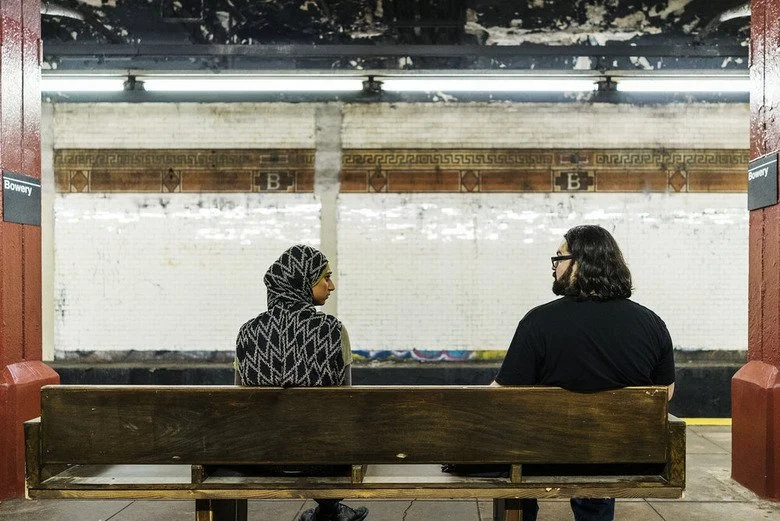
Azhar Khan and Sunita Mani, portraying Mobley and Trenton respectively in Mr. Robot (2015), IMDb
Shama, known predominantly as Trenton, is a supporting character in the first three seasons of 2015 techno-thriller television show, Mr. Robot, which follows a brilliant yet troubled programmer who finds himself part of a plot to take down a corrupt megacorporation alongside Trenton and others. She is introduced as a hijabi Muslim woman of Iranian background and a member of a hacker collective named “fsociety.” After the group’s initial hack later produces unintended consequences, Trenton is eventually forced into hiding, and from this point forward, she is no longer depicted wearing a hijab. The show never acknowledges the change, either through explicit explanation or dialogue. Instead, viewers are forced to invoke their own knowledge and come to the conclusion that this change can only be explained by Trenton’s need for disguise. As one Reddit user interpreted it, “the lack of hijab is presumably a choice to change appearance and not be recognized and blend in.”
In Race and Arab Americans Before and After 9/11, author Evelyn Alsultany describes the "state of exception" as a moment of crisis where established codes and rights integral to one’s identity are suspended for the sake of "necessity.” In Mr. Robot, Trenton’s need to disguise herself from a dangerous entity creates this narrative state of exception. Through this framework, the writer acts as a sovereign power who decides that the emergency of the plot justifies the suspension of the character’s religious practice. But even then, I argue that Trenton's sudden unveiling was not made integral to the plot in the way other character unveilings have been, to signal “freedom from oppression”. The removal of her hijab simply was—no acknowledgement from the plot, no struggle with faith, no non-Muslim boyfriend, just the audience and their own inferences. If anything, the change detracted from the plot; the show makes it abundantly clear that her enemy has no trouble with locating their persons of interest, so this futile disguise attempt (and no other change to her appearance, mind you) is so laughably frustrating that it prompted me to reflect on unveilings in other media I’ve consumed.
Dahlia Qadri, in season 14 of Grey’s Anatomy, quickly rips off her hijab to use as a tourniquet on a patient (in a hospital no less), a scenario so ludicrous and difficult to believe that the state of exception just barely holds up. Marjan Marwani, in season one of 9-1-1: Lone Star, falls through a grain silo and comes out hijabless, long hair flowing gracefully in the wind before men come rushing to cover her with jackets. Was it not tied up beneath the hijab? Where did her undercap go? Zero sense is attempted to be made here, my suspension of disbelief is completely shattered, and once again a woman’s hijab is used in service of heartwarming moments to show how self-sacrificial good Muslim women are and how heroic their male coworkers can be by helping cover them when they inevitably tumble through a grain silo and lose all accessories.
Characters consistently having their hijab written off their heads at some point for any wild reason begs a connection beyond the surface-level “hijab is oppressive” sentiment that found a home in the West—Trenton and many other characters are initially depicted wearing hijab in a positive, non-coercive manner . But without fail, they must appear on screen without it on, sending the message that hijab cannot exist as a neutral, autonomous choice and cementing it as a form of racial project disguised as the will of a character but in reality puppeteered by the writer’s will. Character arcs like Trenton’s tell audiences that women themselves have no innate agency and don’t truly get to decide whether their hijab stays on or comes off—the story will force it either way, and she remains ever at the mercy of who holds her pen. This penchant for submission has been the case no matter what lifestyle a woman lives—to quote Franz Fanon, “This woman who sees without being seen frustrates the colonizer. There is no reciprocity. She does not yield herself, does not give herself, does not offer herself.” The key theme here is control: whether a woman chooses to dress covered or uncovered, someone in control—colonizer, man, writer—must force a change they deem fit. Ironically, the writers of Mr. Robot, a show deeply entrenched in anti-establishment themes, strip a Muslim character of a major part of her identity, perfectly in line with the establishment. The pattern we see with Muslim characters is that they cannot simply exist as themselves; a change is forced, to show that a lifestyle of their own decision is not ‘normal’.
The way I see it, the hijab is often perceived—by writers or audiences—not so much an intentional symbol of human faith as it is a handy vehicle with which to drive forth a story or idea in a quick, convenient manner. This not only muddles its true personal and religious significance, but instrumentalizes hijab in a broader reflection of how countless Arab and Muslim Americans are tokenized and stripped of autonomy to serve Western media narratives, whether positive or negative ones.
Trenton was an example of my personal favorite form of representation: a Muslim character existing visibly without being made solely to carry dialogue about her faith, a person who just happens to be Muslim, doing cool things between Dhuhr and Asr. That said, Muslim characters whose stories do heavily revolve around their faith can and have been done well; think the recent example of Latif in Bassam Tariq’s action-thriller Your Mother Your Mother Your Mother, proof that Muslims are flawed humans and may struggle with their religious choices in film & TV just as in real life, but with the key condition that it adds value to the greater context of the story. In a film about a man trying to hold onto religious practice that seems to be slipping from his fingers in the midst of a violent and emotionally turbulent time, a newfound struggle to establish prayer sounds appropriate. Conversely, in a techno-thriller about underdog hackers going after exploitative corporations, the sudden and slighted removal of a hijab carries no significance. All it does is trivialize the intention and sanctity behind a woman’s choice to wear hijab, and by extension, minimizes the importance of all women’s choices.
With that, Trenton joins the long list of hijab-wearing Muslim characters in western media to remove the veil. Granted, her life was in danger, and it is a known fact in Islamic tradition that one’s survival takes priority above non-foundational religious obligations. Nonetheless, her story is someone’s fictional creation, and it was not written in a vacuum. Think back to an example you know, and notice that it adds to the almost obsessive pattern of western-written hijabis who, at some point, from gritty dramas to coming-of-age comedies, all find themselves in the same place: sans headscarf, sans agency.